Event · April 17, 2026
Prompting Good Hackathon 2026: 13 AI prototypes for real problems in Mexico
The lab and the School of Communication brought together 60 participants from eight schools, who built working apps in a single day using vibe-coding tools.
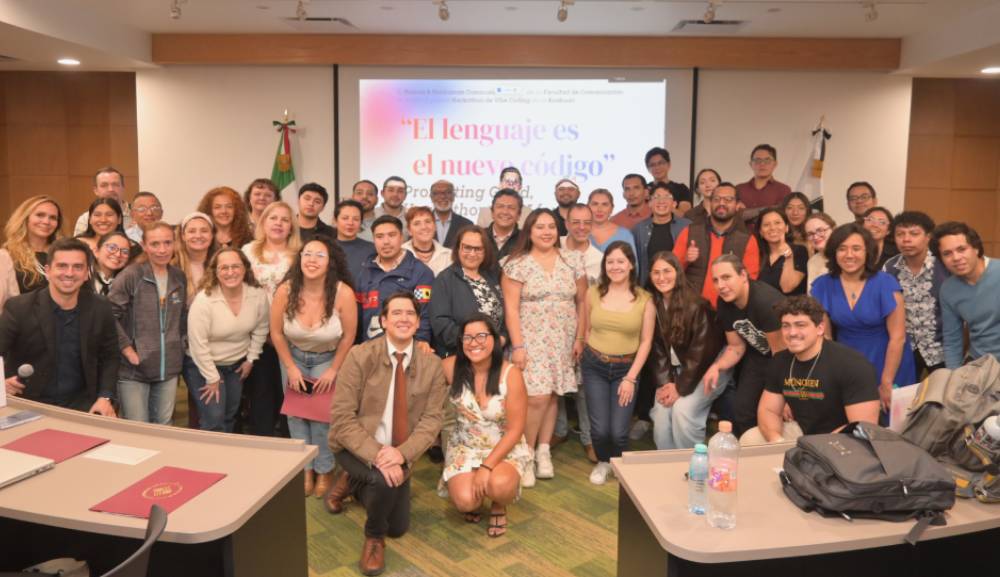
On April 17, 2026, Universidad Anáhuac México showed that artificial intelligence can already be a tool for immediate social intervention. At the Prompting Good Hackathon 2026, 60 participants designed working apps for real problems in Mexico in a single day.
Context
The event was organized by the School of Communication and the Human & Nonhuman Communication Lab, in partnership with Lovable and Telcel. It brought together students from eight schools, staff, researchers, academics, journalists, professionals and guests from other universities, with backgrounds in business, design, the humanities and creative fields.
The challenge: deliver a working app in one day using vibe coding platforms, that is, building software through natural language without traditional programming.
What happened
The event's method, “Think twice, prompt once”, put structured thinking ahead of technical execution. The 13 multidisciplinary teams set abstract ideas aside and focused on concrete urgencies in Mexico; one of the prototypes, for example, was a safety app for women that works offline.
“Prompting Good is clear proof that high-level technological innovation can also be born from communication.”
Projects were assessed on 10 criteria, including research, prompt engineering and feasibility. The jury was mixed: academics from Anáhuac and UNAM, the general public, and an artificial intelligence agent that judged on equal terms with the humans.
Key ideas
“We want to widen who gets to create technology. At Anáhuac we teach how to think with AI and build what could once only be imagined.”
Dr. Covas acknowledged that no one solves gender violence or informal work in a hackathon, but stressed that it is possible to show AI is a concrete tool to start tackling these problems.
Why it matters for the lab
Putting an AI agent on the jury is part of the lab's research programme, which studies how artificial intelligence systems take part in decision-making alongside people. It connects with the lines Communication, agents and social systems and Knowledge, learning and human agency.
“Having an AI agent on the jury is not an isolated experiment: it is consistent with the scientific questions we ask every day in the lab.”
With these results, the School of Communication takes an active role in the technology ecosystem and announced a second edition of Prompting Good.